

A Quick Guide To Employment Pass Category 1 vs 2 vs 3
The MISHU team receives questions on Employment Pass applications from local employers and foreign entrepreneurs every day, and perhaps the most common enquiry is some variation of:
Does my application fall under Category 1, Category 2, or Category 3?
To be honest, most of the time the answer is not that hard to determine, and ours is always based on the seniority of the role:
- anything at the level of a director or organisation-level decision maker goes under Category 1
- anything that mainly focuses on technical execution with no managerial tasks goes under Category 3, and
- everything in between the execution-heavy and top-level leadership roles probably fit best under Category 2
However, the significant impact EP category has on salary requirements causes employers to get in touch hoping we will tell them their application can be submitted under a lower category – and unfortunately, the answer is probably not! 
A Category 1 role needs a Category 1 application.
In all our years handling EP applications, approval always requires alignment between role, candidate, and category – and corresponding minimum pay!
If that’s all, we wish you a smooth application, and for further clarity read on as we break things down by category.
Of course, all are welcome to get in touch directly with our resident EP expert Ariff.

Otherwise, let’s begin.
Category 1 vs 2 vs 3 at a glance
As of 2026, here are the different use cases, requirements, and perks afforded to the three different Employment Pass categories.
| Category 1 EP | Category 2 EP | Category 3 EP | |
| Max validity period | 10 years | 10 years | 5 years |
| Minimum pay | RM20,000 / month | RM10,000 / month | RM5,000 – RM7,000 / month |
| Dependents |
|
Same as Category 1 | Same as Category 1 |
| Interviewing local candidates | Not necessary | May be necessary | Necessary |
| Succession plan | Not necessary | Necessary | Necessary |
| Typical use cases | Shareholders, top leadership, and technical experts | Mid-level technical, managerial, and supervisory roles | Junior technical and semi-skilled roles |
Additional notes
- foreign directors and shareholders fall under Category 1
- all EP categories allow the same dependents subject to standard Immigration requirements
- a succession plan explains how the company will train a Malaysian employee to eventually replace the expatiate
- the local interview requirement is for any role that pays RM15,000 and below, and requires advertising on a specific job portal, interviewing locals, then submitting a Hiring Outcome Report explaining why none of the interviewees were suitable
Immigration evaluates EP applications holistically, looking for consistency between employee qualifications, proposed role, salary, and selected EP category. Any attempt to ‘game’ the system, such as appointing a senior employee under Category 3 with a RM5,000 salary, is very likely to be flagged and rejected, and the applying organisation risks getting blacklisted from hiring expatriates.
When to go with a Category 1 EP

Category 1 is reserved exclusively for senior decision-making roles, namely:
- C-suites
- directors
- majority shareholders, and
- other top level leadership positions
Since they carry the highest requirements, applications under this category are the least likely to be the result of a dishonest application and typically receive less scrutiny from Immigration compared to the other lower categories. Additionally, because the roles come with a minimum salary of RM20,000 / month, they are typically exempt from the job vacancy posting and local candidate interview requirement – assuming the hiring company already has a candidate in mind, they can proceed straight to submitting an application.
When to go with Category 2

Unlike Category 1 which is designed for the highest leadership positions, Category 2 is a more general category for any non-key position that has a minimum salary of RM10,000, which is practice usually means mid-level management / supervisory roles in between senior decision-makers and junior employees.
Because Category 2 is at risk of being abused by employers hoping to bring in a Category 1 tier candidate at a lower salary, in our experience applications under this category receive the strictest scrutiny of all, and even minor causes for doubts will trigger queries from Immigration. That said, a genuine application under Category 2 (or any category for that matter) has little to fear, and roles that pay above RM15,000 are typically also exempt from having to interview local candidates before proceeding to the application.
When to go with Category 3

Category 3 Employment Passes are meant for junior roles that come with a minimum salary requirement of RM5,000, or RM7,000 for roles in the manufacturing sector. In theory, this category could be used for mid-level candidates so long as they are comfortable with the salary and less prestigious job description, but it’s no guarantee and entirely at Immigration’s discretion whether or not to allow it. All applications under this category can only proceed after two weeks of posting the vacancy on MyFutureJobs and submitting a Hiring Outcome Report.
The risks of incorrect EP category selection
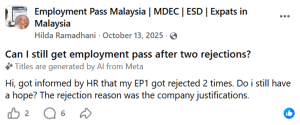
Depending on the severity of issues with an EP application, it will either be returned or rejected:
- a return is usually due to minor technical errors that can be resubmitted as soon as they are corrected
- a rejection is usually due to serious issues that leads Immigration to believe the candidate or role does not meet EP requirements, and the employer has 14 days from the date of rejection to submit an appeal
If the appeal is also rejected, and Immigration believes the mistake was done deliberately, they may take further action such as blacklisting the employer from hiring foreigners for several years, and every subsequent application receives added scrutiny that delays the process. An incorrect EP category would most likely fall under cause for a rejection, not a return, and so the MISHU team always make a big deal out of the category, role, and salary aligning!
Let MISHU handle your EP applications
Our team maintains a 98% success rate across our Employment Pass applications and renewals across all three EP categories and can provide end-to-end foreign talent hiring assistance from ESD account registration to securing MyFutureJobs support letters, handling Immigration queries on your behalf, and more.