


Our team enjoys a 98% success rate across our Employment Pass applications and renewals over the years, and can provide end-to-end foreign talent hiring assistance from ESD account registration to securing MyFutureJobs support letters, handling Immigration queries on your behalf, and more.
A Guide To Malaysian Employment Pass Requirements & Applications Steps
Employment Pass (EP) applications in Malaysia are submitted by hiring organisations and strictly evaluated by Immigration authorities, requiring clear alignment of foreign candidate, role, salary, and EP category.
Even then there are no guarantees.
For those unfamiliar with the process or who have faced rejection, this guide draws upon MISHU’s years of experience facilitating visa applications to explain essential considerations to secure your first EP.
Here’s how we’ve broken it down:
- EPs from ESD vs MDEC vs IRDA vs MIDA
- the role of Xpats Gateway
- employer, expatriate & role requirements
- Employment Pass categories
- key evaluation factors
- common reasons for rejection
- application journey and timeline
- fees and required documents
- alternative expatriate work visas, and
- the benefits of engaging a service provider
Of course, you’re welcome to get in touch directly with our resident EP expert Ariff.

Otherwise, let’s begin.
ESD vs MIDA vs IRDA vs MDEC
As of 2026, four separate regulatory bodies in Malaysia review and approve / reject EP applications:
- Malaysian Investment Development Authority (MIDA)
- Iskandar Regional Development Authority (IRDA)
- Malaysia Digital Economy Corporation (MDEC)
- Malaysian Immigration Department
The application procedures, documents, processing stages, and requirements are similar for all four, but each is responsible for a specific category of EPs, and employers must determine which agency their applications will fall under.
MIDA Employment Passes

MIDA handles EP applications for manufacturing and selected FDI-heavy industries via the MIDA Expatriate System (MES) which is part of their bigger InvestMalaysia portal.
IRDA Employment Passes
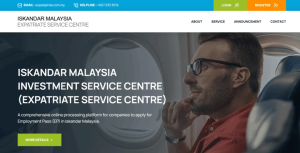
IRDA exclusively manages expatriate applications for businesses located within Johor’s Iskandar Malaysia region through XPATNOVA.
MDEC Employment Passes

MDEC handles expat applications (Foreign Knowledge Workers) for MD Status companies and other tech sectors via their MDEC Expats platform.
ESD Employment Passes

Meanwhile, the Expatriate Services Division (ESD) under the Malaysian Immigration Department is the default catch-all body that handles applications for virtually all other employers throughout Peninsular Malaysia, and the rest of this guide mainly references applications from them.
To recap, employers must register an account on the correct agency’s platform, and the correct one is:
- MES for manufacturing operations or MIDA-regulated businesses
- XPATNOVA if based in Iskandar Malaysia
- MDEC Expats if seeking MD Status or operating in tech sectors
- ESD for almost everything else in Peninsular Malaysia
Regardless of which regulatory body will review an EP application, it will need to go through a separate platform known as Xpats Gateway.
Xpats Gateway
While the MES, XPATNOVA, MDEC Expats and ESD platforms above assess applications, employers must submit them through Xpats Gateway.
Also for future EP renewals.
This is central platform that integrates various agency databases throughout Malaysia to facilitate obtaining expatriate visa supporting documents. Once submitted, EP application status can be tracked via the employer’s ESD, XPATNOVA, MES, and MDEC account.
Employer requirements
To sponsor expatriates and submit Employment Pass (EP) applications, the hiring organisation must meet eligibility criteria by the Malaysian Immigration.
Legal entity registration

The employer must be a legally registered entity in Malaysia, most commonly a Sdn Bhd or LLP under the Companies Commission of Malaysia (SSM), or a society registered under the Registry of Societies (ROS).
Paid‑up capital (private limited companies)
Sdn Bhds must meet minimum paid‑up capital requirements based on the percentage of foreign equity:
- 100% Malaysian‑owned: RM250,000
- Joint venture with ≥30% foreign equity: RM350,000
- 100% foreign‑owned: RM500,000
WRT / USS license (foreign‑owned entities)
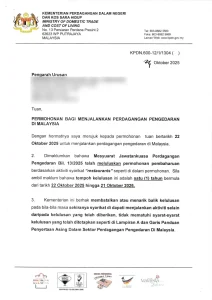
Sample WRT license.
Businesses with more than 50% foreign ownership in Malaysian trade and service sectors are required to submit proof of a valid Wholesale, Retail & Trade (WRT) or Unregulated Services Sector (USS) license upon EP application.
These licenses require a minimum paid-capital of RM1 million, and potentially more depending on the specific sector. For details, see our guide to WRT license applications.
ESD account registration
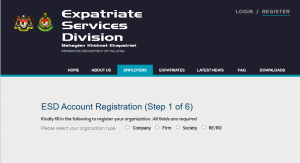
Those who are eligible based on the above criteria must also register and activate an ESD employer account through which all EP applications are submitted, tracked, and later renewed.
And as mentioned earlier, depending on the circumstances an employer may have to register with MDEC, IRDA, or MIDA instead.
Operational credibility
Immigration will use the submitted supporting documents to assess the company’s substantive business presence in Malaysia, including:
- active operations
- tax compliance
- financial capacity to support expatriate salaries, and
- approvals from sector regulatory bodies
Put simply, the more established an operation, the higher the chances of a successful application.
Foreign professional requirements
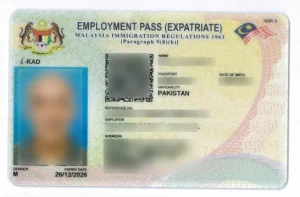
Foreign talents are assessed based on formal qualifications, work experience, and potential of breaching visa conditions.
Academic qualification and experience
The expatriate must meet one of the following qualification thresholds:
- Degree holder with minimum 3 years of relevant experience
- Diploma holder with minimum 5 years of relevant experience
- Technical certificate holders with minimum 7 years of practical experience
All academic qualifications must be in a field relevant to the role and Certified True Copy (CTC).
Immigration history
Applicants are expected to have a clean immigration record, and previous overstays, blacklisting, or improperly cancelled work passes may negatively affect approval prospects and should be addressed before submission.
Role requirements

MyFutureJobs employer portal.
The sponsored role must:
- be managerial, executive, or technical in nature, and
- require specialised skills or expertise that cannot be easily filed by local candidates
Additionally, for most roles with salaries <RM15,000, employers must make efforts to hire locally through job postings on MyFutureJobs that last for at least 14 days.
Employment Pass categories (updated for 2026)
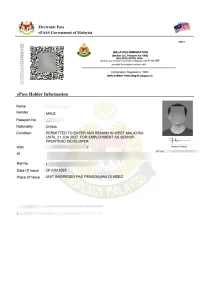
Sample Category 1 EP for senior technical role.
Malaysia has three Employment Pass categories designed for different levels of role seniority, and Immigration only approves applications if role, pay, and applicant profile align with category.
| Category | Minimum salary | Validity period | Dependants | Typical roles |
|---|---|---|---|---|
| 1 | RM20,000 | 10 years | Permitted (spouse and children under 18) | Directors, C‑suite executives, senior management |
| 2 | RM10,000 | 10 years | Same as Category 1 | Managers, professional specialists, subject‑matter experts |
| 3 | RM5,000 (RM7,000 for manufacturing roles) | 5 years | Same as Category 1 | Technical specialists, junior executives |
All three categories can be renewed indefinitely for the duration of the validity period so long as the employment arrangement continues and can be upgraded as salary / roles change.
Category 2 and 3 EP applications must also include a clear succession plan detailing how the employer will eventually replace the expatriate’s role with a local hire within a specified period.
A recap of key evaluation factors
The ideal application will look like this:
- Job title, responsibilities, and salary clearly aligns with selected EP category
- The applicant’s resume and qualifications demonstrate genuine specialised expertise
- The applicant has a clean travel and immigration history
- All qualifications are Certified True Copy
- For roles with salaries <RM15,000, employers have tried to hire locally through MyFutureJobs
- The employer has the financial capacity to sustain the expatriate’s minimum salary
- Sector-specific endorsements from regulatory bodies have been obtained
Remember that Immigration evaluates EP applications holistically so just because numerical requirements are met on paper, doesn’t mean approval is guaranteed!
At the same time, those handling the application should take care to avoid the main reasons for returns and rejection.
Common reasons for rejection

Besides issues with applicants which cannot be helped, most EP rejections or returns are due to technical or procedural non‑compliance, especially:
- missing or improper MyFutureJobs advertisements
- incorrect or incomplete CTC academic certificates
- absence of required WRT or USS licences for foreign‑owned companies
- submission of new EP applications while the applicant is physically in Malaysia
- misalignment between salary, job scope, and EP category
These issues absolutely can be helped, so take care to avoid them as rejected applications not only delays this hiring but can cause all future applications to receive stricter scrutiny.
EP application fees
As of April 2026, ESD charges the following for EP applications:
- RM2,000 application fee
- RM200 (for every year of EP validity) endorsement fee
For eligible applicants who want to bring their family, the fees are as follows:
- RM550 for every dependent visa application (including processing)
- RM90 (for every year of dependent visa validity) endorsement fee
Please note these fees do not factor in SST (currently at 8%) or third party service charges.
Required documents
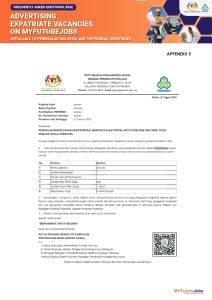
Sample MyFutureJobs support letter.
While there may be additional supporting documents needed, a typical EP application requires the following:
- full colour copy of passport
- Certified True Copy academic certificates
- updated resume or CV
- stamped employment contract
- job description on company letterhead
- MyFutureJobs support letter (if applicable)
- JTK or sector‑specific approval letters
Typical EP journey & timeline
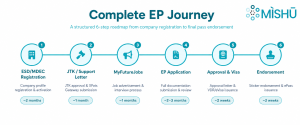
An employer’s very first-time EP application typically takes around six months, depending on document readiness, sector approvals, and Immigration workload.
| Stage | Description | Estimated time |
|---|---|---|
| 1. ESD registration & activation | Company profile registration and activation on the Expatriates Services Division (ESD) portal | ~2 months |
| 2. JTK / XPats Gateway approval | Workforce approval and issuance of support letter (where applicable) | ~1 month |
| 3. MyFutureJobs compliance (if needed) | Job advertisement and local interview process (if required) | ~1 month |
| 4. Employment Pass submission | Full EP application submission, review, and Immigration assessment | ~2–3 months |
| 5. Approval & visa issuance | Approval letter and issuance of VDR or eVisa | ~2 weeks |
| 6. Endorsement & ePass | Entry into Malaysia and final endorsement (sticker or ePass issuance) | ~2 weeks |
Two things to note:
- For future applications, there is no need to register another ESD account.
- Applications for roles paying above RM15,000, especially for key positions under Category 1 do not need MyFutureJobs compliance stage.
Renewals are significantly faster and can often be done in one to two months.
That said, this is a good time to bring a possible EP alternative to your attention.
EP vs Professional Visit Pass (PVP)
Employers who cannot currently meet the salary requirements for an EP may consider a Professional Visit Pass (PVP) for their expatriate hiring needs.
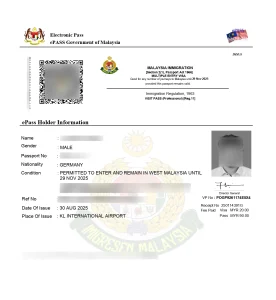
We suppose they all look the same.
Here’s a quick side by side comparison of the two.
| Criteria | Employment Pass (EP) | Professional Visit Pass (PVP) |
|---|---|---|
| Purpose | Long‑term employment with a Malaysian company | Short‑term assignments, projects, training, or consultancy |
| Work arrangement | Formal employment contract with local entity | Remains employed by overseas company (in most cases) |
| Salary requirement | RM3,000 – RM10,000 (higher after June 2026) | No minimum salary |
| Validity | 1 – 5 years (longer after June 2026) | Up to 12 months total |
| Renewability | Infinitely renewable | Renewable once (and not guaranteed) |
| Dependants allowed | For Category 1 & 2 | No |
| MyFutureJobs requirement | Required for most roles <RM15,000 salary | Not needed |
PVPs are used for short‑term arrangements such as hiring for technical projects, training, or consultancy engagements. They are also generally only valid for up to 12 months including extensions, and do not allow dependants or long‑term employment.
But they allow eligible employers to hire expatriates with no minimum salary requirement so while not a perfect substitute for an EP, PVPs can serve as an interim solution in certain business scenarios.
And with that, all that’s left is a shameless plug for our services!
Why engage MISHU for your EP application
While employers can handle their own EP applications, we hope the guide has shown the process is far from straightforward. As everything must be followed correctly, inexperienced applicants have a high risk of being rejected all because one form wasn’t stamped correctly!

Many of our clients came to us after feeling Immigration’s love of forms and checklists.
An experienced visa service provider reduces risk by:
- pre‑evaluating eligibility
- ensuring correct EP category selection
- managing ESD and MyFutureJobs compliance, and
- verifying documentation before submission
Furthermore, they are also experienced in handling follow up queries from Immigration officers and can help direct expatriates with where to go and how to speak to officers when arriving in Malaysia.
In short, for a relatively small additional fee, employers and expatriates both enjoy a smoother application free from mistakes they might have unknowingly made.
This obviously doesn’t just apply to us but to any of the highly capable visa application service providers in Malaysia – but we’d obviously prefer you to hire MISHU over them!