


Our team maintains a 98% success rate across our Employment Pass applications and renewals and can provide end-to-end foreign talent hiring assistance from ESD account registration to securing MyFutureJobs support letters, handling Immigration queries on your behalf, and more.
The Foreign Business Guide To Malaysian Expatriate Work Visas
The MISHU team has been helping foreign ventures expand into Malaysia for many years, and as part of the process, we facilitate work visa applications for personnel relocating to support the Malaysian entity setup.

Everything short of flying the plane
If you are such a business, your employees will most likely require either an Employment Pass (EP) or Professional Visit Pass (PVP), and as a rule:
- EP if the employee will be hired and paid by the Malaysian entity
- PVP if the employee remains employed by the foreign parent while carrying out a short-term task for the Malaysian entity
Both can easily take up to eight months to be approved, so the sooner a decision is made, the less likely waiting for visas becomes a bottleneck!
For a complete understanding of the process, read on as we cover:
- choosing between EP or PVP
- selecting the right EP category
- ESD vs XPATNOVA vs MES vs MDEC
- Xpats Gateway
- employer requirements
- expatriate requirements
- required supporting documents
- application process, timelines, and fees, and
- avoiding returns and rejections
Of course, all are welcome to get in touch directly with our resident EP expert Ariff.

Otherwise, let’s begin.
Choosing between an EP or PVP
Both are work visas that allow skilled foreigners to stay in Malaysia, and as the introduction said, the general rule is:
- EPs are for expatriates joining the Malaysian company as full-time employees
- PVPs are for team members who will remain employed by the overseas parent while undertaking a short-term task in Malaysia
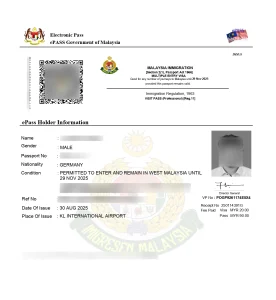
Sample PVP.
In most cases, EPs are better suited for permanent relocations or staff who need to bring family members, while PVPs are ideal for temporary transfers that will conclude within 12 months, especially for younger team members.
| EP | PVP |
| Long-term employment | Temporary assignments |
| Valid for up to 5–10 years | Maximum 12 months |
| Dependents permitted | No dependents allowed |
| Minimum salary thresholds | No minimum salary |
| Malaysian payroll | Overseas payroll |
As an overseas business has both a foreign and Malaysian entity that can work out either arrangement, both options can be available depending on the assignment and team member.
Choosing the correct EP category
Unlike the single-tier PVP, Employment Passes are offered under three categories based on the seniority and expected salary for such a role.
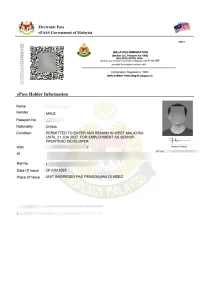
Category 1 EP for senior technical decision-maker.
Immigration only approves applications where qualification, role, salary, seniority and selected category align, so choosing the right one is extremely important.
| Category | Use case | Typical roles | Min salary | Max validity |
| 1 | Senior leaders and decision makers | CEO, Managing Director, Country Manager | RM20,000 / month | 10 years |
| 2 | Mid-level management and specialists | Department Manager, Finance Manager, Engineer, Software Developer, Consultant, Regional Specialist | RM10,000 / month | 10 years |
| 3 | Junior professional and technical positions | Analyst, Junior Engineer, Sales Executive | RM5,000 / month (RM7,000 in manufacturing roles) | 5 years |
Additional notes
- Category 1 EPs is the visa for foreign directors and shareholders
- All EP categories allow dependents, subject to standard Immigration requirements
- Category 2 and 3 applications are expected to include a succession plan explaining how the company will train a Malaysian employee to eventually assume the role
- Category 1 applications are generally more straightforward as senior leadership positions naturally justify higher salaries and expatriate appointments
- Immigration evaluates EP applications holistically, looking for consistency between the employee’s qualifications, seniority, proposed role, salary, and selected EP category
- any attempt to ‘game’ the system, such as appointing a clearly senior employee under Category 3 with a RM5,000 salary, is very likely to be flagged and rejected
ESD vs MES vs XPATNOVA vs MDEC
As of 2026, four separate agencies review Malaysian work visa applications:
- Malaysian Investment Development Authority (MIDA)
- Iskandar Regional Development Authority (IRDA)
- Malaysia Digital Economy Corporation (MDEC)
- Malaysian Immigration Department
Each manages a different group through a separate platform, and businesses must determine which has jurisdiction over their Malaysian entity.
MIDA handles expat applications for manufacturing and selected investment intensive industries through the MIDA Expatriate System (MES) which is part of their bigger InvestMalaysia portal.

IRDA exclusively manages expatriate applications for businesses located within Johor’s Iskandar Malaysia region through XPATNOVA.
MDEC handles expat applications (Foreign Knowledge Workers) for MD Status companies and other tech sectors via their MDEC Expats platform.

Meanwhile, the Expatriate Services Division (ESD) under the Malaysian Immigration Department handles applications for virtually all other employers throughout Peninsular Malaysia.

The correct platform is therefore:
- MES for manufacturing operations or MIDA-regulated businesses
- XPATNOVA if based in Iskandar Malaysia
- MDEC Expats if seeking MD Status or operating in tech sectors
- ESD for almost everything else in Peninsular Malaysia
Across all four separate platforms, application procedures, supporting documents, processing stages, and Immigration requirements are very similar, including how they integrate Xpats Gateway.
Xpats Gateway
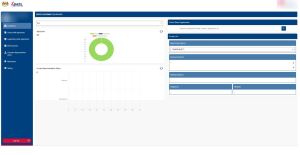
Xpats Gateway interface.
While the four platforms previously mentioned assess applications, employers must submit them through Xpats Gateway, a central platform linked with various agencies to facilitate obtaining supporting documents.
Once submitted, application progress can be monitored through your respective ESD, XPATNOVA, MES, and MDEC account.
With that out of the way, let’s look at who can actually apply.
Employer eligibility requirements

Regardless of whether your application falls under ESD, XPATNOVA, or MES, the Malaysian entity is always the visa sponsor, not the overseas parent.
This means your business must first establish a Malaysian legal entity, and for subsidiaries in the form of a Sdn Bhd, Immigration also expects minimum paid-up capital based on foreign ownership:
- JV with at least 30% foreign equity: RM350,000
- 100% foreign-owned: RM500,000
Companies with 51% or more foreign ownership will also likely need either a Wholesale, Retail & Trade (WRT) or Unregulated Services Sector (USS) license.
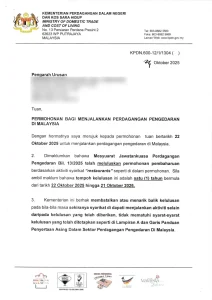
WRT license sample.
Both these licenses require RM1 million paid-up capital.
Finally, Immigration assesses whether the Malaysian entity genuinely has the operational presence and financial capacity to support the expatriate position and salary being applied for.
Expatriate & role requirements

Like most countries, Malaysia evaluates foreign employees based on three broad considerations:
- academic qualifications
- professional experience
- immigration history
In addition, Immigration also considers whether the proposed position genuinely requires foreign expertise.
Academic qualifications and experience
The employee should satisfy one of the following qualification thresholds:
- Degree holder with at least 3 years of relevant professional experience
- Diploma holder with at least 5 years of relevant experience
- Technical or professional certificate holder with at least 7 years of practical experience
Qualifications should be directly relevant to the proposed role and submitted as Certified True Copies (CTC) where required.
Immigration history
Applicants should have a satisfactory immigration record. Previous overstays, unresolved immigration issues, or improperly managed work passes may affect an application and should ideally be resolved before submission.
Role
Whether for an EP or PVP (but especially EP), Immigration evaluates whether the position justifies employing a foreign national instead of local talent.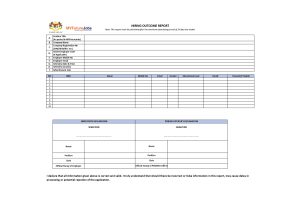
Sample Hiring Outcome Report.
For EP roles with monthly salaries below RM15,000, employers must also demonstrate efforts to recruit locally by advertising on MyFutureJobs for at least 14 days, interviewing locals, and submitting a Hiring Outcome Report.
As we’ll elaborate on later, this adds significantly more time to the application process, and must be done for each role that falls under this salary threshold, so if multiple team members will be relocating, it’s best to get all the job ads out of the way concurrently.
Required documents
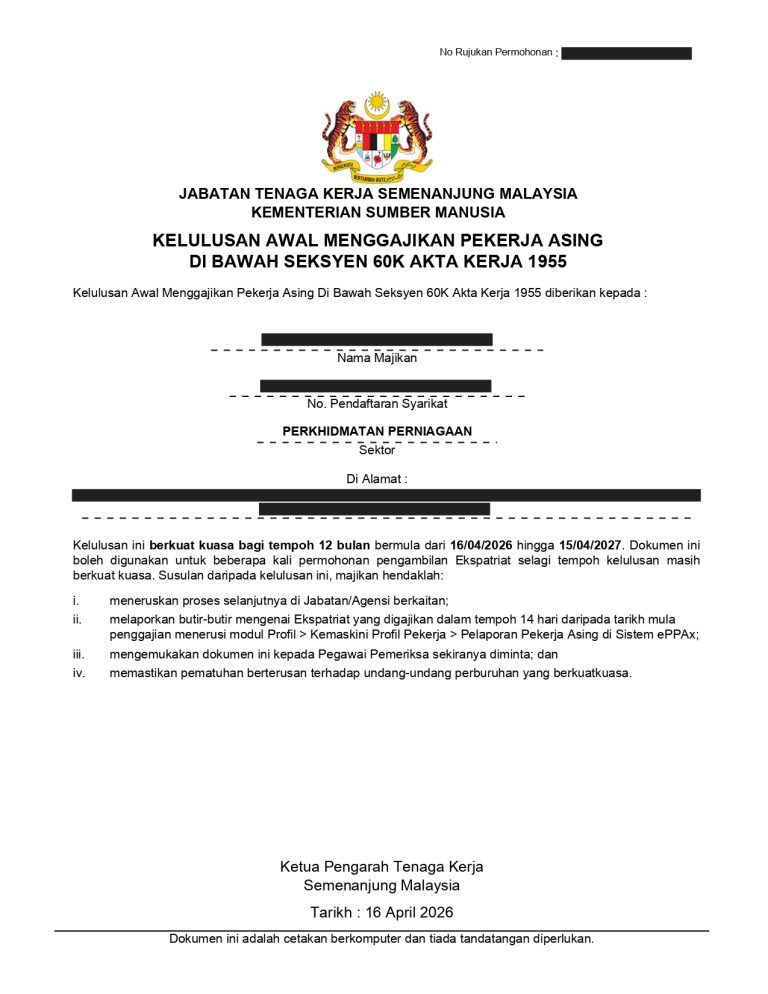
Sample JTK approval letter under Section 60k.
Although supporting documents vary by industry, most applications follow a common checklist, and typical documents for an EP application include:
- full colour copy of passport
- Certified True Copy academic certificates
- updated resume or CV
- stamped employment contract
- job description on company letterhead
- MyFutureJobs support letter (if applicable)
- JTK or sector-specific approval letters
- security bond form (duly stamped by Inland Revenue Board)
- personal bond form (duly stamped by Inland Revenue Board)
- bank guarantee (for Chinese and Bangladeshi nationals)
Most documents for a PVP application are similar, except employment-related documents are replaced by assignment documents, including:
- offer letter, service agreement, sponsor agreement, or internship letter
- confirmation of overseas employment
- month-by-month work schedule
- project scope or assignment details
Certain industries also require additional approvals, so get in touch for a better idea of your specific supporting document needs.
Application process & timeline
A company’s first EP or PVP typically takes six to eight months based on document readiness, sector approvals, and Immigration backlog.
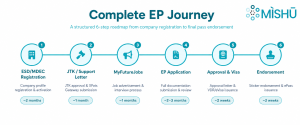
This consists of five to six main stages depending on the type of visa.
| Stage | Description | Estimated timeline |
| 1. ESD / XPATNOVA / MES registration | Company registration and activation on the ESD / XPATNOVA / MES portal | ~2 months |
| 2. JTK / Xpats Gateway approval | Workforce approval and support letter (where applicable) | ~1 month |
| 3. MyFutureJobs compliance (if required) | Local recruitment advertisement and interview process | ~1 month |
| 4. EP / PVP application submission | Immigration assessment and processing | ~2–3 months |
| 5. Approval & visa issuance | Approval letter together with VDR or eVisa issuance | ~2 weeks |
| 6. Endorsement & ePass | Entry into Malaysia and final endorsement | ~2 weeks |
For full details on what each stage entails, see our breakdown of Malaysian EP processing times, but the above is a pretty good summary.
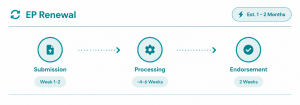
Work visa renewals are much faster.
Companies only need to register an ESD / XPATNOVA / MES account once, so future visa applications begin at Stage 2, and roles earning >RM15,000 are typically exempt from MyFutureJobs advertising, so Category 1 and some Category 2 applications enjoy faster processing by skipping a step.
Finally, EP renewals are significantly faster and can often be approved in one to two months.
Application fees
The whole process can be self-managed by employers, in which case the main costs will be Immigration fees, since ESD, MES, and XPATNOVA account registrations are free.
That said, professional visa agencies exist for a reason: Dealing with government agencies can be time-consuming, especially for foreigners!
To help readers, we’ve summarised budget estimates for self-handled applications versus different levels of outsourcing to MISHU:
| Pass Type | Self-managed | Outsourced application (Stage 4–6) | Outsourced end-to-end (Stage 1–6) |
| PVP | RM1,400–RM1,700 / application | + RM3,500 / application | + RM7,000–RM9,000 for full application support |
| EP | ~RM2,500 / application (for 1-year endorsement) | + RM4,000 / application |
For full details, our breakdowns explain each cost item, the work involved, and why we charge what we do:
While self-managed costs are fixed, third-party charges obviously differ between providers, so feel free to use ours as a benchmark 🙂
Now for our last section – and one of the main reasons agencies exist – avoiding common reasons for work visa rejections!
Avoiding rejected work visa applications
Disclaimer: We’re assuming the application satisfies Immigration rules, as no amount of tweaking is likely to make a difference otherwise. That said, even eligible applications can be returned or rejected.
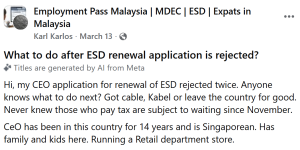
Here are the most common reasons and how to avoid that from happening.
Returned applications
A returned application is usually caused by technical, documentation, or submission issues such as:
- passport photos that do not meet Immigration specifications
- names or personal details that do not match passport information
- missing company stamps, signatures, or required endorsements
- incomplete supporting documents or agreements
- poor-quality scans or incorrect file formats
- missing Certified True Copy (CTC) documents where required
- gaps or inconsistencies in the candidate’s CV or employment history
Rejected applications
A rejected application usually indicates doubt about the suitability of the candidate, role, or employer. Common reasons include:
- the candidate’s stated experience does not sufficiently match the role
- the role does not appear specialised or suitable for foreign talent
- the employer’s financial profile does not support the application
- the job scope, title, salary, and candidate background are not aligned
- the role does not demonstrate a clear need for a foreign employee
Again, assuming the application genuinely satisfies Immigration guidelines, carefully reviewing the entire application before submission goes a long way—and this is where a visa agency can certainly help.
This obviously applies to any capable visa service provider in Malaysia, but we’d naturally love for you to choose MISHU.
That’s it from us, and we wish you all the best with your expansion 🙂